

KILLER CRAYFISH
How to effectively imitate Canada’s freshwater crustaceans
Advertisement
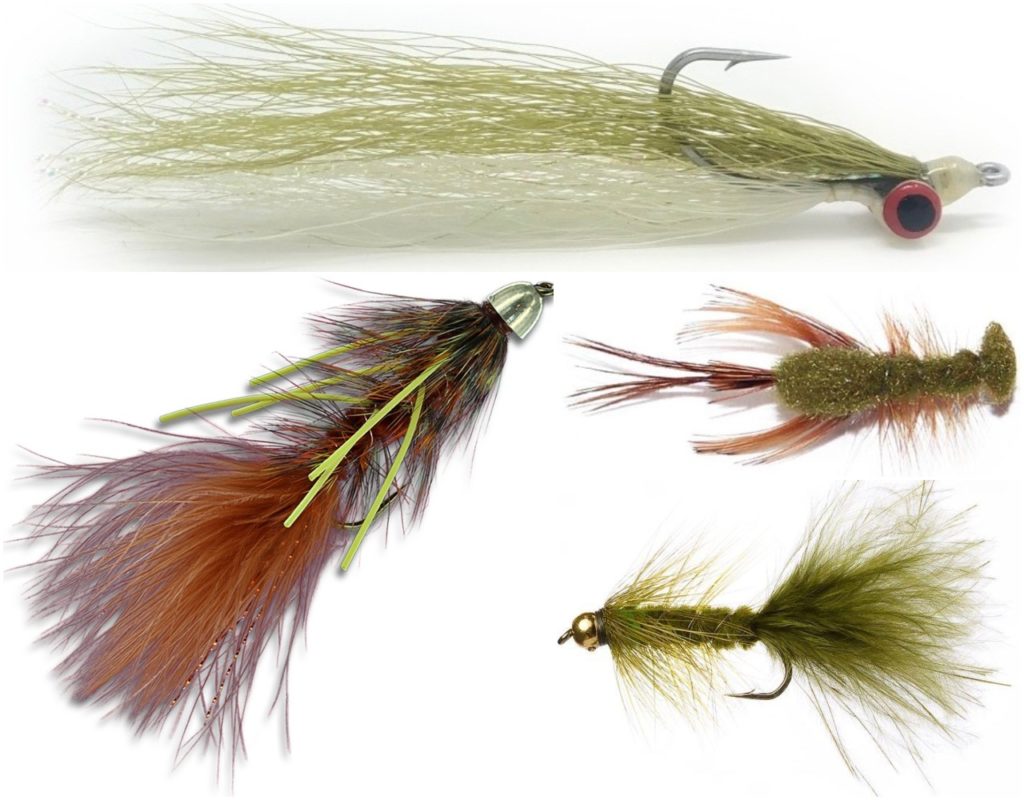 Clockwise from top: Clouser Deep Minnow, Clouser Crayfish, Bead-Head Woolly Bugger, Autumn Splendour
PROPER PATTERNS
Many crayfish flies faithfully imitate the crayfish’s prominent claws, legs and sturdy carapace. But these hyper-realistic flies have a wee flaw—they don’t work. That’s because humans and gamefish understand crayfish very differently. We tend to focus on the pincers, so many fly patterns include big, waving claws. We know from fisheries researchers, however, that fish much prefer crayfish with smaller, or even missing, claws. That’s because those pincers are potentially dangerous defensive weapons.
Crayfish shells are also hard to digest, providing low energy value to a trout or bass compared to a soft, fleshy minnow. So, why are they such common prey? For the same reason I might crave a slab of prime rib, but end up eating hot dogs—crayfish tend to be a meal of convenience or last resort. Like a leftover pack of hot dogs, craws aren’t the choicest of entrées, but they’re handy when you’re hungry.
Advertisement
Since crayfish represent an expedient meal, a good crayfish fly needs to—above all—look easy to eat. That means smaller claws are a must. In fact, as long as it seems alive and vulnerable, the fly only has to be vaguely crustacean-like. After all, spin anglers clean up by dragging and hopping plain old tube jigs. So, forget hyper-realism and pick a crayfish fly that’s darkish in colour, with bits that are a little wiggly, but not intimidating. It should also be weighted to stay near bottom.
It’s probably no coincidence that two of the world’s most popular flies—the Bead-Head Woolly Bugger and the Clouser Deep Minnow—make pretty darn good crayfish imitations. The Clouser Crayfish, which has wispy feather claws and a spongy-looking shell, is another fly that gets it right. My all-time favourite is the Autumn Splendour, which is a scraggly Bugger variation with rubber legs and a denser hackle. It’s cheap and easy to tie, and it looks great in the water. But how you fish it is just as important…
REALISTIC RETRIEVES
Crayfish flies are a little more versatile than you might think, and there are several ways to fish them—as long as you get them down deep. Most patterns are weighted, but in water deeper than a few feet, you usually need to add weight or use a sink-tip line (or a full-sinking line in lakes and ponds). As always when fishing deep, keep your leader short, between four and six feet. Otherwise, the fly will ride up and away from the bottom debris, ledges and rocks that make for prime crayfish habitat.
Advertisement
In rivers, fish craw flies the same way you’d fish deep streamers, by banging the banks or swinging them downstream. Crayfish aren’t powerful swimmers, and sometimes they get dislodged and swept downstream—just like a free-floating nymph or an injured baitfish—so a dead drift can also be surprisingly effective (even under a strike indicator). It’s also worth fishing tail-outs and back eddies, where bass, in particular, patrol for bigger meals.
In lakes and ponds, there’s no magic retrieve formula. Brisk pulls of four to 12 inches mimic a startled crayfish, and sometimes this will get a predator’s attention. But you can also use a slow retrieve with occasional small hops, like a crayfish going about its business, blithely unaware it’s in danger. Big fish often pin craws to the bottom with a blow intended to crush and disable them, so strikes are hard to miss. When fish hunt craws, they come ready to rumble—and you should, too.
Advertisement
Learn how to tie the Autumn Splendour and other crayfish flies at www.outdoorcanada.ca/crawflies.