


GAME PLAN
Hunting’s role in conserving Canada’s Serengeti of the North
Advertisement
My first up-close look at B.C.’s famed Muskwa-Kechika wilderness was through the ears of a horse winding up Gathto Creek, a tributary of the Muskwa River. That was roughly 30 years ago during a 12-day elk hunt, but I still remember the diversity and abundance of game our party saw—despite only exploring a tiny part of the vast 6.4 million-hectare landscape.
Riding above the treeline one morning, for example, we encountered a group of nine bull moose and eight cows; I still don’t understand how or why they were together like that. In the end, my friend and I each took a mature bull elk—I lost much of mine to a marauding bear—while the two B.C. residents in our party were successful in taking mature Stone’s rams.
Advertisement
Today, the Muskwa-Kechika region remains one of the wildest, most pristine, game-laden landscapes in Canada and beyond. In fact, it’s often referred to as the “Serengeti of the North” because of its rich ecological diversity. And for that, the hunting community can take a large part of the credit.
ABUNDANCE OF WILDLIFE
The Muskwa-Kechika has a storied hunting history, most notably as the place where Lee Sherman Chadwick shot the standing world-record Stone’s sheep in 1936; today known simply as the Chadwick ram, it’s said to be the greatest big-game animal ever taken in North America. Since that time, the region has been considered one of North America’s premier hunting destinations, and many affluent hunters and outdoor luminaries, including renowned American writer Jack O’Connor, have made the pilgrimage to hunt the vast wilderness.
Advertisement
Over time, as the stories and game trophies piled up, the outfitters and guides who led hunters through the Muskwa-Kechika’s mountains and valleys have become as well-known as the region itself. Names such as Lynn Ross, Don Peck, Garry Vince, Leo Rutledge and several others are still talked about with reverence, long after they took their last pack train up a favourite creek.
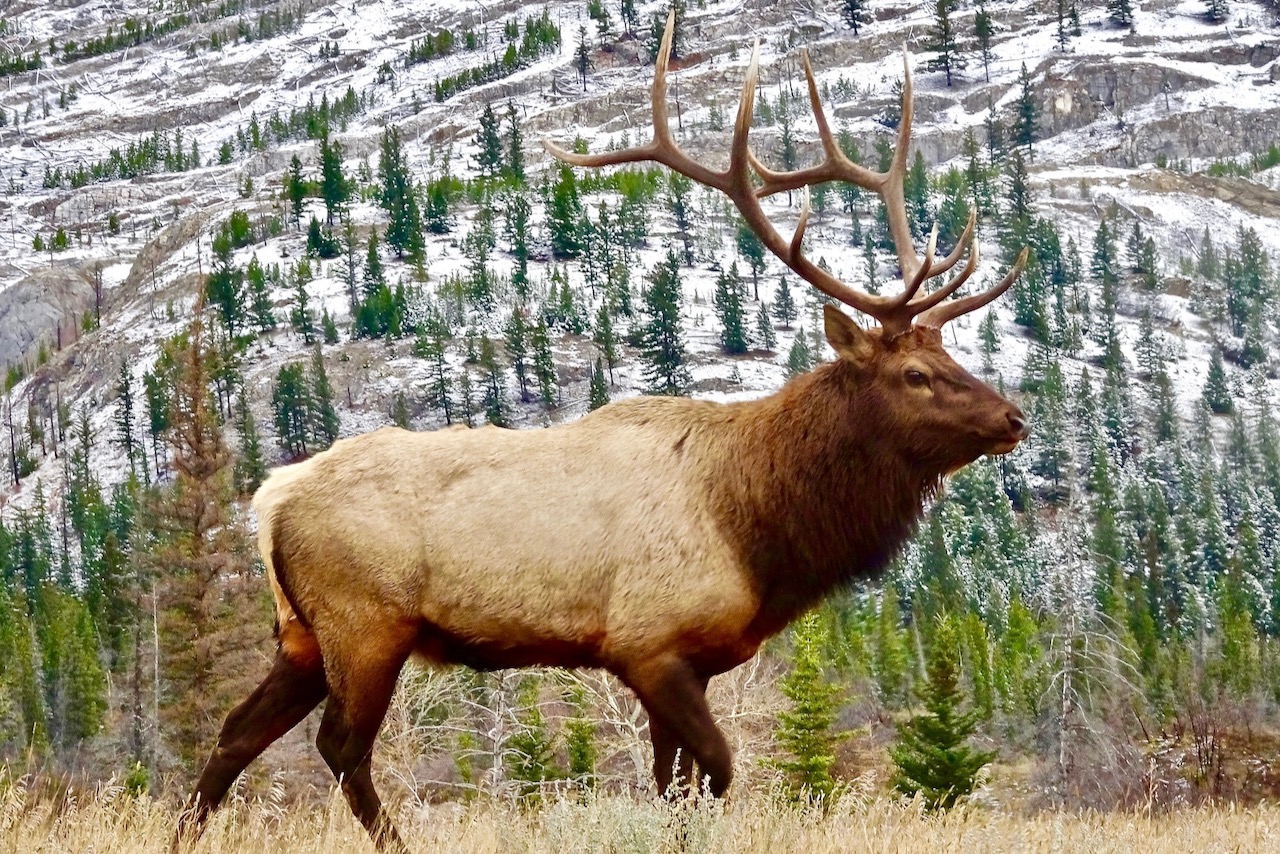 The Muskwa-Kechika teems with wildlife (photo: Siggy Nowak/Pixabay)
So, why is the Muskwa-Kechika so exceptional from a wildlife perspective? How have we managed to maintain such a massive wilderness area with healthy populations of elk, moose, Stone’s sheep, mountain goats, black bears, grizzlies, wolves, bison, mountain caribou, mule deer and whitetails? There’s isn’t one easy answer.
For starters, there’s the low density of roads. Considering the Muskwa-Kechika is roughly twice as large as Vancouver Island, it’s amazing to think the only major route through the region is the Alaska Highway. Beyond that, there are only a few resource industry roads that tickle its fringes. All other travel is either by air, water or horseback.
Minimal industrial development and the sheer size of the region itself also contribute to the rich biodiversity. Perhaps most importantly, however, is the Muskwa-Kechika’s history of active wildlife management.
MODEL OF MANAGEMENT
For decades, both the hunting community and wildlife officials have had a hand in maintaining and enhancing the region for wildlife. Unsanctioned prescribed burns were common at one time, and by the late 1970s, government officials themselves had adopted the tool as a way to increase the quantity and quality of early- to mid-seral stage habitats. That included the grasslands and grass-shrub complexes so critical to maintaining large ungulate populations. (As we’ve sadly discovered elsewhere, total fire suppression leads to homogenous, old-grown habitats and the resulting slow disappearance of most large mammals.)
Predator management has also contributed to the sustainability of the Muskwa-Kechika’s ungulate populations. At various times, culling programs have been instituted to help keep wolf populations in check.
Perhaps most important to the current and future maintenance of the region’s astounding biodiversity is B.C.’s Muskwa-Kechika Management Area Act. Under the 1998 legislation, several levels of protection were established to conserve the wilderness—some areas would be turned into parks, while others would allow limited mining, logging, and oil and gas activities. A consensus-based advisory committee of volunteers was established to ensure that governments, First Nations, industry and other relevant stakeholders would all collaborate in determining management strategies moving forward.
As a result of all this, the Muskwa-Kechika now stands as a model that should be followed elsewhere. It demonstrates that where the will exists, massive tracts of largely undeveloped wilderness can co-exist with development through cooperative and responsible land-use management. And that’s a win for everyone—including hunters.