

HIDDEN GEM
Longing for a winter escape? Mexico’s tropical Chetumal Bay offers the best saltwater fly fishing you’ve never heard of—until now
Advertisement
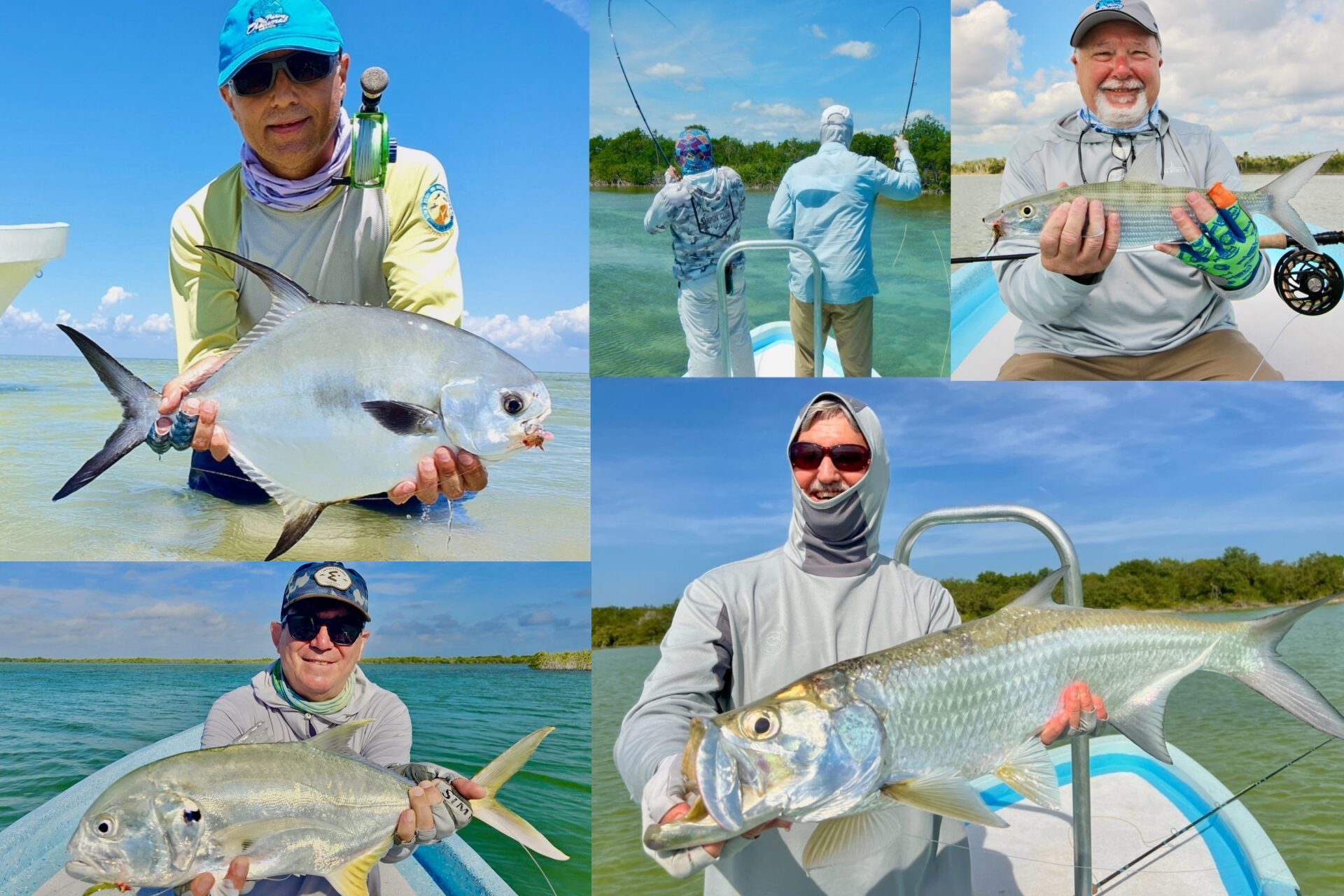
 Common flats fish include (clockwise from top left): permit, juvenile (aka “baby”) tarpon, bonefish and snook
THE FISH
One of the other popular tropical destinations for Canadian fly anglers is the Out Islands of the Bahamas, which share many of the same fish species with Mexico’s Caribbean coast. The fisheries differ greatly in character, however. The Bahamas are primarily a bonefish destination, famous for vast, hard-bottomed flats that teem with fish, often in large schools. With its shallow, turtle-grass lagoons, on the other hand, Chetumal Bay offers anglers a chance at all of the major species found on Mexico’s Caribbean coast. That includes the Grand Slam trio of bonefish, tarpon and permit, along with feisty snook, barracuda and jacks.
Bonefish are common throughout the bay, averaging one to three pounds in size, with a chance at one twice as big. Permit, the holy grail of flats fishing, are present year-round. In addition, snook lurk among the mangrove roots and creek mouths, along with other species that aren’t considered prime gamefish, but still fun to catch. You’re also likely to see various jacks and large cuda, which can pop up on the flats at any time. It’s a thrilling mix.
Advertisement
 Adult tarpon in Chetumal Bay can reach 150 pounds
Then there are the tarpon, including both resident juveniles and migratory adults, which provide heart-stopping fly action. The resident fish—known as “baby tarpon”—range from 10 to 40 pounds, and can be found in the mangrove-lined backcountry. Migratory giants up to 150 pounds, meanwhile, appear in the basin from May through September. Those fish are a particular specialty for Carlos, who has personally landed dozens of huge specimens, and is an expert at finding and landing the mighty silver king.

Saltwater gear has to be tough, but not necessarily expensive
Advertisement
THE TACKLE
Success in saltwater demands proper equipment, though that doesn’t mean taking out a second mortgage. Mid-range tackle will do just fine, so long as it’s rated for saltwater. Along with fast- or medium-fast-action rods, you’ll need a reel tough enough that it won’t fall apart during blistering 100-foot runs. All your fly lines should be weight-forward tapers, and buying premium ones is usually worth the investment.
For bonefish, snook and baby tarpon, you’ll need an 8- or 9-weight rod with a floating line. For permit, which are larger and like bulkier crab flies, a 9- or 10-weight rod paired with a floating line handles most situations. When targeting large tarpon, step it up to a 10-, 11- or 12-weight rod. Ideally, you want a pair of rods, one with a floating line, and one with an intermediate sink-tip to get down into the deeper water of five or six feet.
Advertisement
If you don’t have all of that gear, you can borrow some from the guides, or pool resources with other anglers. Just be sure to bring one outfit you’ve practised with and are comfortable using. If you’ve never cast anything bigger than a trout rod, standing on the deck of a boat as a tarpon rolls ahead of you is not the time to learn.
 Top Chetumal flies include (clockwise from top left): Crazy Charlie, Veverka Mantis Shrimp, EP Crab and Peanut Butter
Some of the top bonefish flies for Chetumal are the Crazy Charlie, Rubber-Leg Gotcha and Veverka Mantis Shrimp in tan, pink and white, and sizes 8, 6 and 4. You don’t need every possible permutation of those flies, just a representative sample. But note the size—they are much smaller than the flies for Bahamas bonefish. For permit, stock the Squimp and EP Crab Fly in sizes 2 and 4. Productive tarpon flies, meanwhile, include the Peanut Butter, Black Death and Tarpon Toad in sizes 1/0 and 2/0.