

LEADER LOGIC
Still tying on a tapered leader? Here’s why they’re obsolete and (mostly) unnecessary
Advertisement
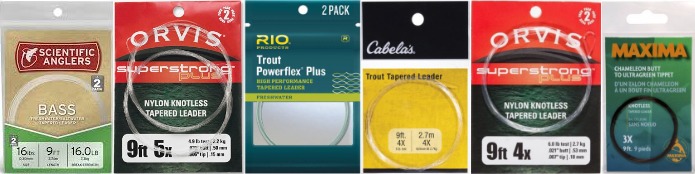 Knotless tapered leaders work great, but are expensive and usually not needed
TAPER TRAP
To be clear, a tapered leader—whether homemade or purchased—does the job. It connects your fly, and straightens out as it should. And every fly-fishing manual in the last 70 years says you absolutely, positively must use a tapered leader.
But here’s the thing: 90 per cent of the time, a straight piece of mono or flouro fishing line does the job just as well. Why? Because modern mono is flexible enough to transfer energy without a taper, especially when combined with today’s colossally improved lines and rods. As fly gear has improved, however, it seems few anglers have bothered to question conventional leader wisdom.
Advertisement
But since the early 2000s, I’ve been using simple one-piece mono leaders for almost all of my freshwater fly fishing. I cut them off 50- or 100-yard spools of Trilene, Maxima, Scientific Anglers or whatever’s handy. The cost works out to about 20 cents per leader, and they cast perfectly. In fact, the most important lesson I’ve learned is that if you can’t get a simple nine-foot mono leader to land straight, you don’t have a leader problem—you’ve got a casting problem.
SIMPLE SYSTEM
For floating lines, I just use a single seven- to 12-foot length of mono, selecting the line strength based on the size of the fly and the fish. For the vast majority of my trout fishing, with flies from size 14 up to size 8, I use six-pound mono. On windy days or when using bigger flies, you need a somewhat stiffer leader, so I’ll go up to eight- or sometimes even 10-pound line. (With the heavier mono, I tie on my fly with a loop knot to ensure it has plenty of action.) I only deviate from this system on the rare occasion when I use a tiny size 16 or 18 fly. Then I’ll add 18 inches of four-pound to the end, just to ensure I can thread the line through the hook’s minuscule eye.
I realize that bucking decades of conventional fly wisdom makes me sound like a member of the tinfoil-hat brigade. But if you don’t believe me, try it yourself. Under identical conditions on the lawn or on the water, cast a tapered leader, then a straight one. Even better, conduct a blind test, with someone else rigging the rod so you don’t know whether you’re casting a straight or tapered leader. I’ll bet you my best trout rod you won’t be able to tell the difference—and that it will change your life.
Advertisement
Learn how to fix fly-casting problems at www.outdoorcanada.ca/flycastfixes.