

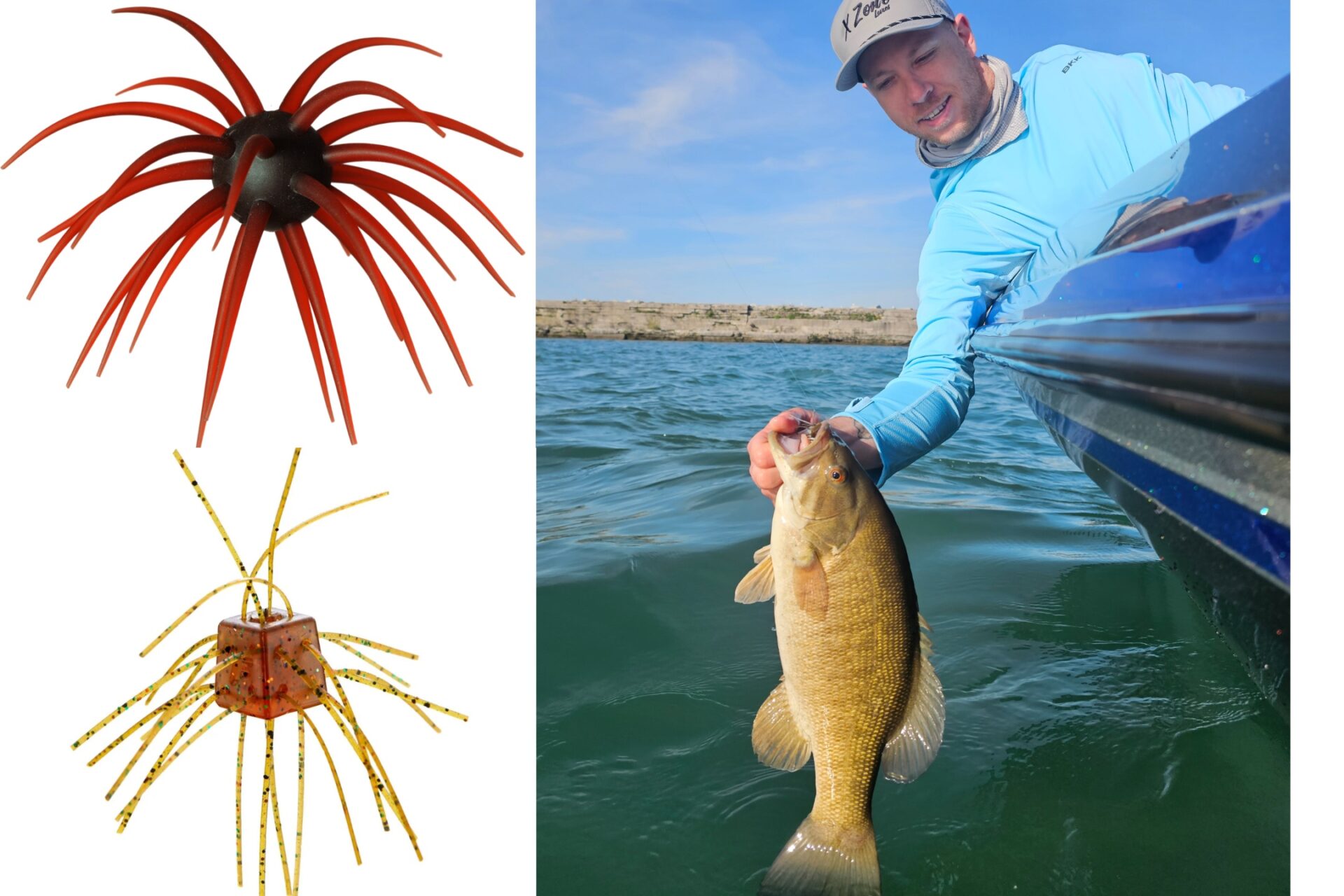

THE NEXT BIG THING
The growing popularity of fuzzy dice and urchin baits is taking the bass-fishing world by storm. But will it last?
Advertisement
 Joey Teofilo (left) and Joey DiCienzo fished fuzzy dice to haul in a record bag of bass (photo: Nicole Pallotta)
THE CANADIAN CONTEXT
These tentacled baits dominated Japanese tournament fishing for years before gaining acceptance in the U.S., and they’ve only really arrived here in Canada in the last year or so. That lag is due to pure geography. Some of the most productive months for these baits south of the border are during the pre-spawn—a time when most Canadian bass waters are either still frozen or closed to protect spawning fish. So, while anglers in the southern U.S. can fish these baits 12 months of the year, Canadians can’t.
The early-spring opening in southern Ontario’s Zone 20 is helping close the gap. The window lines up close enough to U.S. pre-spawn timing that anglers here can get time on these baits when the fish are very reactive. It’s not the only productive window in Canada, but it is a significant one. For the average Canadian angler, it’s the closest thing we’ve ever had to the time-on-water advantage American anglers take for granted.
Advertisement
While Johnston and the two Joeys agree on why these baits work, they arrive at the same conclusion from different angles. Johnston’s theory is based on fish psychology. “I think they’re very curious creatures, and when they’re pressured fish, they’re like, ‘I’ve never seen something like that,’” Johnson says. “They go up, and they are curious, and they want to see what it is and feel it. They don’t have hands, so they just eat it.”
When fish are “live-scope shy,” a properly presented novel bait can get a bite when nothing else will
The Joeys, on the other hand, offer similar insight, but from the tournament-strategy side. In a 150-boat field where every angler is throwing the same minnow imitation on a drop shot at the same fish, for example, the bait that gets bit is the one the fish have not seen before. So, a fuzzy dice in place of a conventional soft-plastic can, and will, trigger reaction bites, they say.
All three also agree that fish are increasingly becoming what the two Joeys refer to as “live-scope shy.” That’s when the fish see a boat, feel the sonar pings, observe the conventional baits, then spook. It’s something the pros are seeing on pressured fisheries in the U.S. Even here in Canada, with less raw boat traffic than the major American lakes, fish are starting to show the same behaviour. Under those circumstance, a properly presented novel bait can get a bite when nothing else will. Enter the fuzzy dice and urchins.
Advertisement