

CHASING THE NORTH-OF-60 TRIPLE CROWN
Magnificent Kasba is home to astonishing numbers of large lake trout, northern pike and Arctic grayling
Advertisement
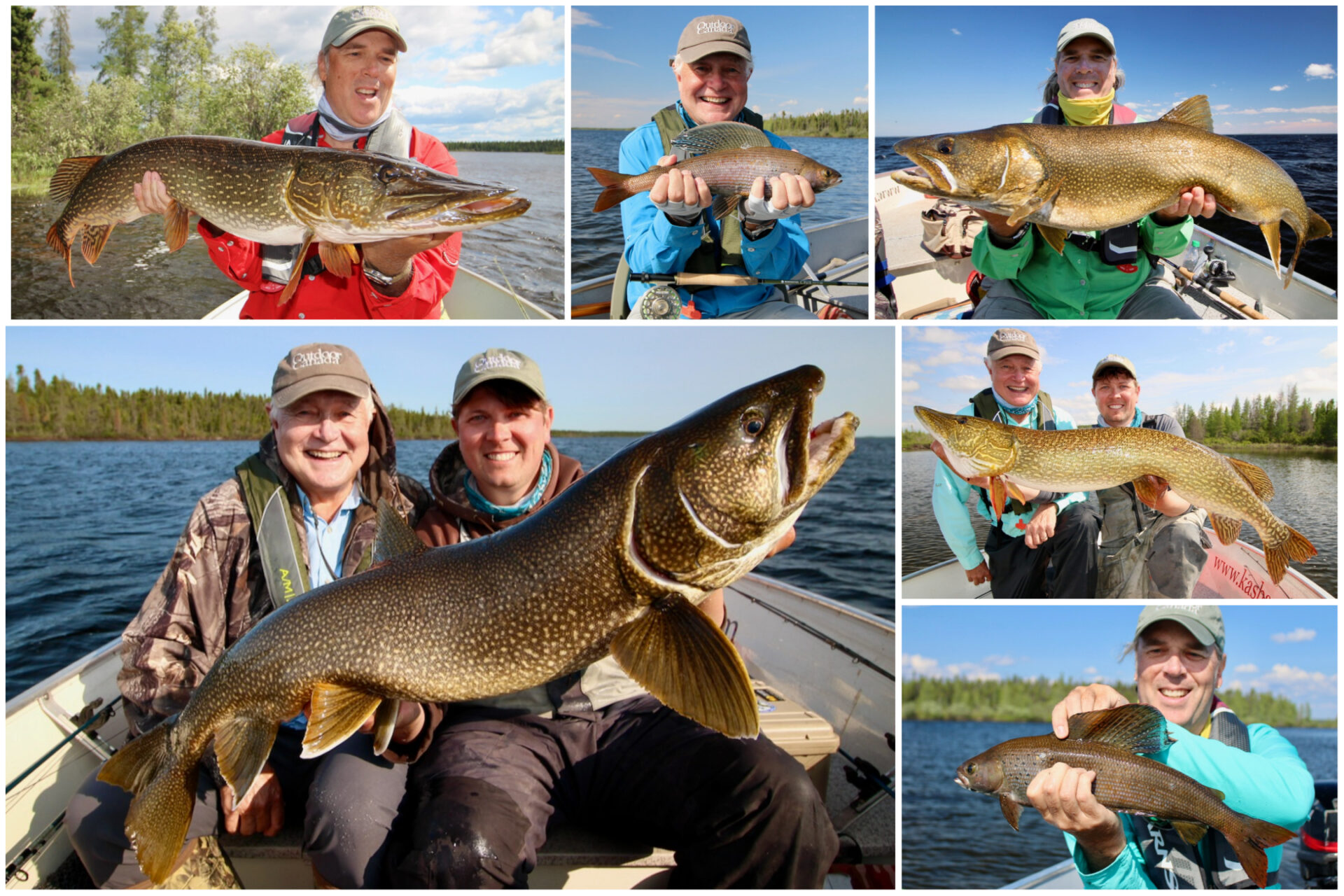 Lake trout, northern pike and Arctic grayling, all caught at Kasba Lake Lodge between July 9-15, 2022
Anglers heading north of 60 into Canada’s immense and unspoiled Northwest Territories are often hoping to catch three iconic species: lake trout, northern pike and Arctic grayling. There’s nowhere better in the world to do it. Northern Canada has more lakers, pike and grayling—and more big ones—than anywhere else on the planet.
Of course, the Northwest Territories also covers over 1.3 million square-kilometres, most of it uninhabited wilderness, so there’s a lot of room for those fish, and a lot of places to cast a line. What’s rare is finding a single destination in that vast region boasting all three species in trophy sizes.
Advertisement
That’s part of what makes Kasba Lake, nestled in the southeast corner of the NWT, so special. This huge, virtually untouched body of water, along with the Kazan River flowing out of its northern end, offers a chance at the triple crown of northern fishing: a 20-pound lake trout, a 40-inch pike and a two-pound grayling.
In fact, I recently completed the Kasba triple crown, just three days into a six-day trip. And it’s not (entirely) because I’m some kind of angling savant. My long-time northern fishing partner Lynn Henning, a sportswriter for the Detroit News, also tripled, as did a number of other anglers during our stay at Kasba Lake Lodge.
I was originally supposed to visit Kasba Lake in 2020, but the trip but was delayed two years by the pandemic. You can build up a lot of anticipation in two years yet, incredibly, the reality exceeded my imaginings. My full feature story about Kasba Lake will appear in a 2023 print issue of Outdoor Canada. But for now, here are seven reasons why this place is so special.
Advertisement
#1 Kasba Lake is like a different world, lost in time
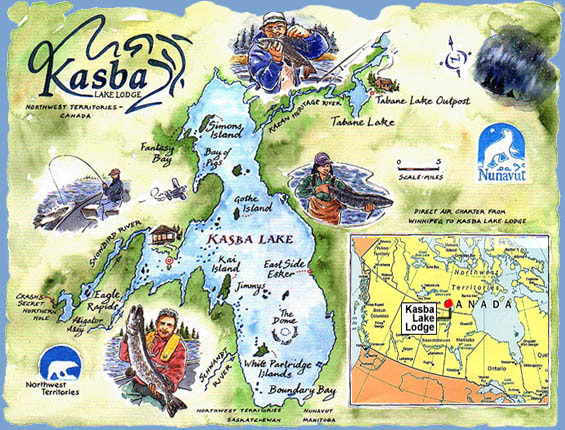
Located in the temperate subarctic, Kasba Lake lies just a few kilometres north of Canada’s “four corners,” where the borders of Manitoba, Saskatchewan, Nunavut and the Northwest Territories meet. At 70 km long, and 35 km wide, it’s a huge body of water, with plunging depths, shallow bays, numerous inflows and outflows, all criss-crossed by eskers, and dotted with dozens of islands. Even better, Kasba is over 200 km from the closest road, and there’s nothing manmade on its shoreline other than Kasba Lake Lodge.
If you were to sit at a drawing table and design a lake to grow big northern fish, this is pretty much what you’d come up with. Add to that literally decades of careful conservation, with all large—and even medium-sized—fish being released to keep growing and spawning, and you’ve got a recipe for world-class angling. On my trip, for example, we kept a total of three four-pound lakers for a couple of shore lunches, and that was it. Everything else went back.
Advertisement
Once you’re just a few minutes away from the lodge’s dock, you can lose yourself among Kasba’s islands and channels and not see a single artifact of modernity all day. As you take in the expanses of water, rocky shorelines, pebble beaches, boggy meadows and sparse forest, you’re looking at a landscape that hasn’t changed since the last ice age, 11,000 years ago. The effect is pretty overwhelming. Even if you don’t fish, it’s an incredible place to visit. But for anglers, it’s pretty much heaven.
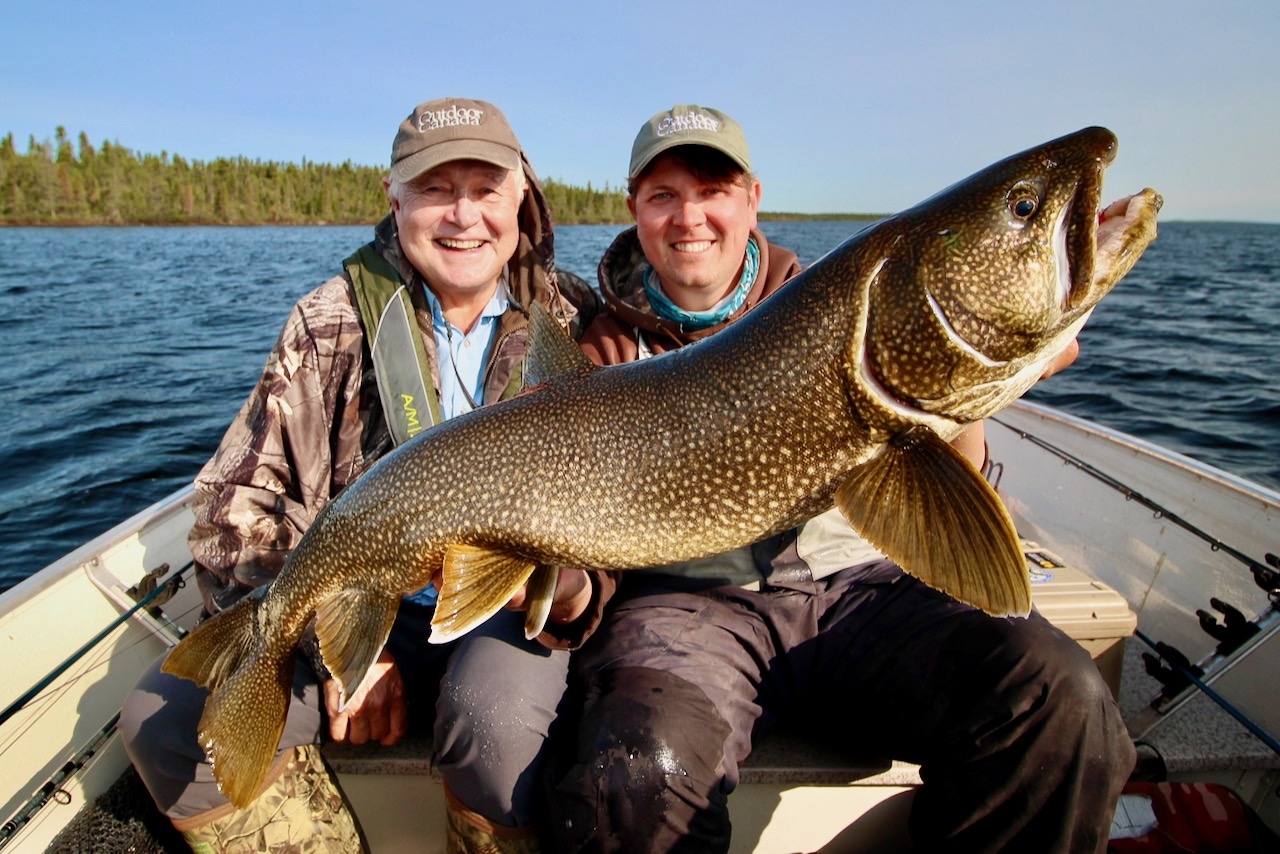 Lynn Henning (left) and guide Tyler Jones with Henning’s 20-pound trout
#2 The lake trout are big and everywhere—and some are really big
Whether you’re a fly angler or a baitcaster, from Texas or Toledo or Toronto, there’s one thing everyone who fishes the north shares: they fall in love with lake trout. Streamlined, beautifully marked and thickly muscled, lakers are fearsome predators, possessed of a speed and strength rarely found in freshwater fish. When I’m fishing around home, a single five-pound lake trout is a great day on the water, and maybe the highlight of a season. Kasba is full of trout that eat five-pounders.
In just three days of targeting trout, Lynn and I had three 20-pound-plus fish in the boat, and dozens of smaller ones. We were specifically hunting for trophies, using very large spoons, plugs, jigs and flies, which lowered our numbers of trout caught, but upped the average size. And wow, do those big trout pull.
I had a donkey of 22-pounder that took a deltoid-popping 15 minutes to land. In fact, before it came into view, we all secretly thought it might be twice as big, but nope—just freakishly strong. Some large lake trout have the perfect physical beauty seen in smaller river trout, just scaled up to huge proportions. But others (and the ones I love best) are sort of beastly and busted looking, as befits a ferocious marauder of the deep. One friend looked at my photo of that donkey laker (below), and replied that it was such a formidable animal, he barely recognized it as a trout.
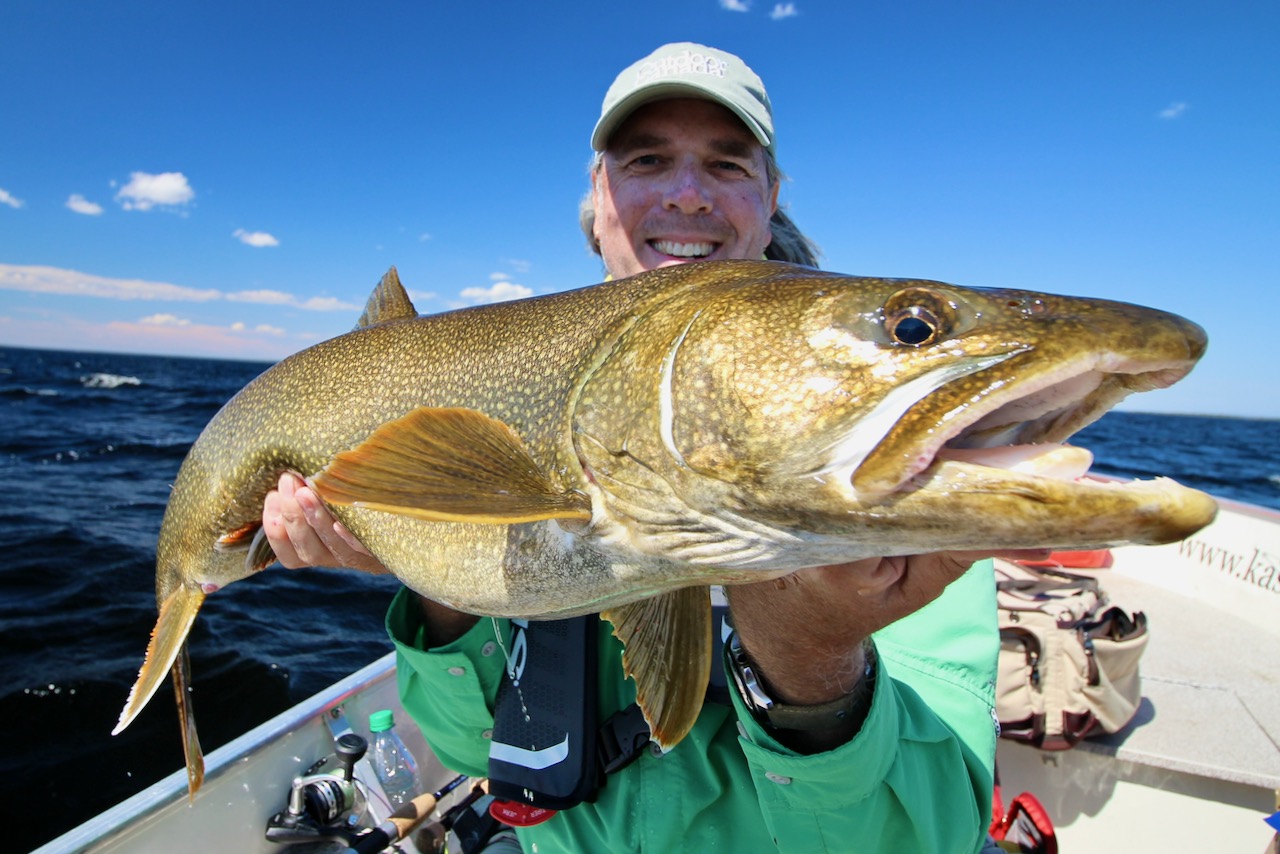 The author’s “donkey” lake trout
You can also rack up out-of-this-world numbers. Our guide, Tyler Jones, from Peterborough, Ontario, said that sometimes guests want fast action so he trolls small (as in only 4-inch-long) spoons or lipless cranks. With these baits, anglers can pull in 5-pound trout literally all day long, catching 50 or, some days, even 100 fish.
The other remarkable thing about Kasba trout is that they’re widely distributed all over the lake. You can haul in big fish at the famous “Dome” structure, some 30 kilometres’ run from the lodge. But you also catch them five minutes from the dock. In fact, during a vicious day-long windstorm, we spent eight hours cruising around in protected channels, never venturing more than 10 minutes from the lodge, and caught two of our three biggest lakers. In between, we took a 90-minute “break” around midday to land a bunch of pike, including a 36-incher. That’s quite a fishery.