

THE UGLIES
These flies may not be easy on the eyes, but they sure do a beautiful job of catching fish
Advertisement
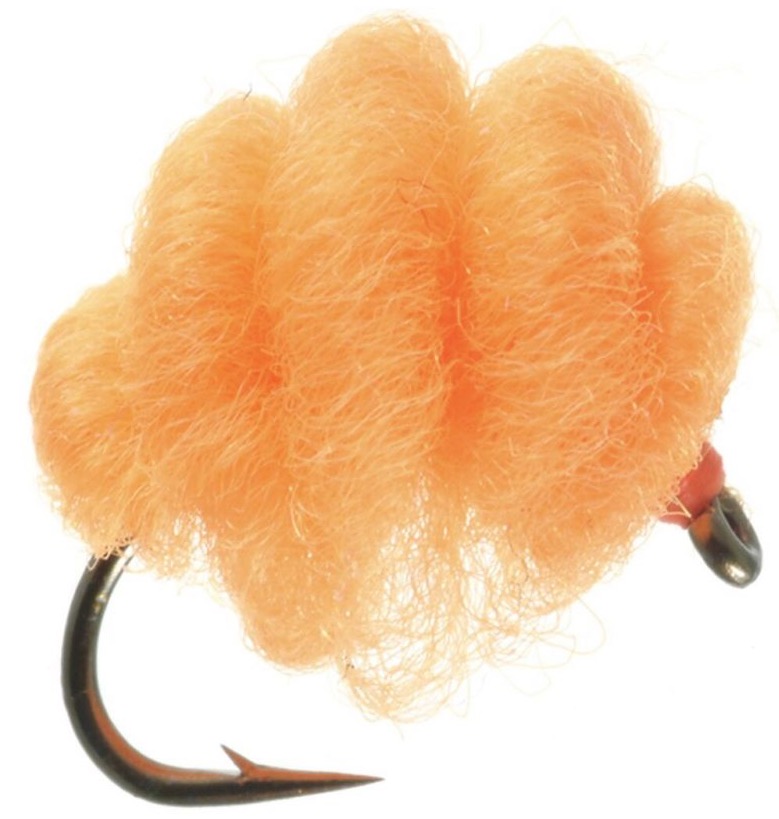
#4 EGG FLY
I don’t have much in common with trout. Our evolutionary paths diverged some 400 million years ago when my distant ancestors crawled out of the sea, and theirs stayed behind. But we both love eggs, and for the same reasons: An egg is a morsel of pure protein, and it doesn’t see you sneaking up behind it, either.
Advertisement
There’s a lingering prejudice against egg flies, presumably because they’re both incredibly simple, and also really dopey looking, especially my favourite version. Most egg flies are a tidy sphere, representing a single egg, but I like the blobby version pictured here, and not just because it resembles the hairdo of a certain recent American president (that fly’s official colour, by the way, is “Oregon cheese” which I find funny, though I can’t explain why). Since steelheaders fish blobby little bags holding a bunch of roe, I figure why not use a fly imitating a clump of eggs, instead of a single one.
Egg flies work during much of the season, likely because various species living in a waterbody spawn at different times, and eggs are drifting around more often than we might assume. And if you have two thumbs and two fingers, you can easily tie one. They’re just tufts or loops of yarn, fluffed out and trimmed into shape, whether it’s a uniform sphere or a blob.
- HOOK: Short-shank wet fly, sizes 8 to 14
- BODY: Yellow, orange, pink or red yarn
Advertisement
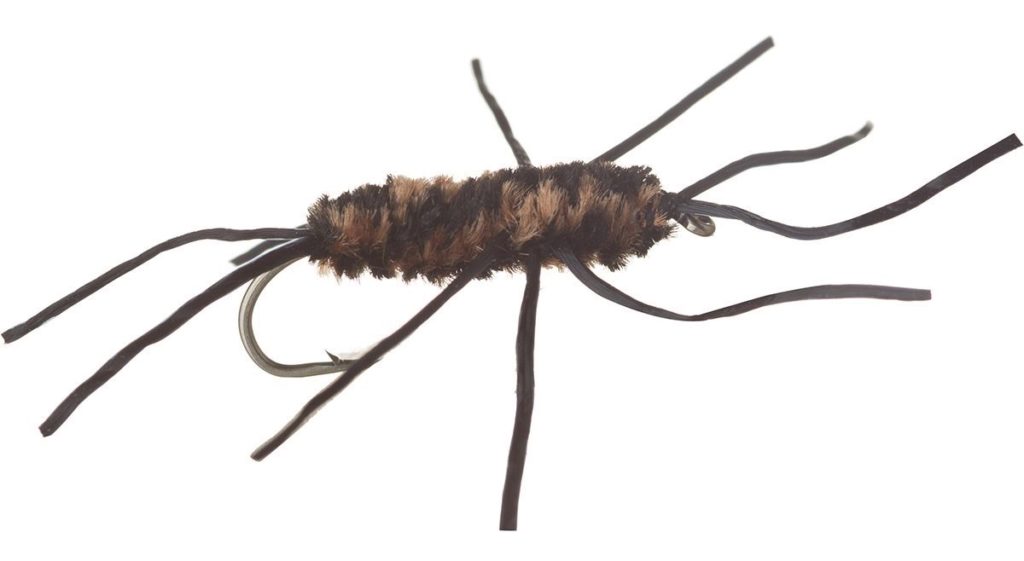
#5 GIRDLE BUG
The dismal Girdle Bug features nothing but a dark body and rubber legs. It is an objectively ugly fly, but beyond aesthetics, the thing is so buggy looking that it squicks me out a little. If some joker left a Girdle Bug by my kitchen sink, I’d start whacking it with the spatula, assuming it had crawled up the drain. But of course, that squick factor is why it catches fish.
Officially, Girdle Bugs imitate stonefly nymphs, which are found across much of Canada, primarily in cold, clear fast rivers with rocky bottoms, especially in the West. When I first started fly fishing in the 1980s, hyper-realistic nymph flies were in vogue, but they were often rather stiff and lifeless in the water. I’ll take the Girdle Bug’s wiggly legs over entomological exactness any day. It works almost anywhere because its erratic movement conveys both life and distress, triggering any predator.
Advertisement
The Girdle Bug has actually been forgotten and rediscovered several times since the 1930s. Back then, fly tiers allegedly took the latex banding from ladies’ girdles and sliced it into strips to make the legs. That explains the fly’s name, and it says a lot about fly tiers, too.
- HOOK: 2XL nymph, sizes 6 to 12
- BODY: Black, brown or mottled chenille
- LEGS: White, black or brown Sili Legs or similar
- WEIGHT (optional): Lead underwire or dark bead head
#6 GRIFFIN’S STIMICATOR
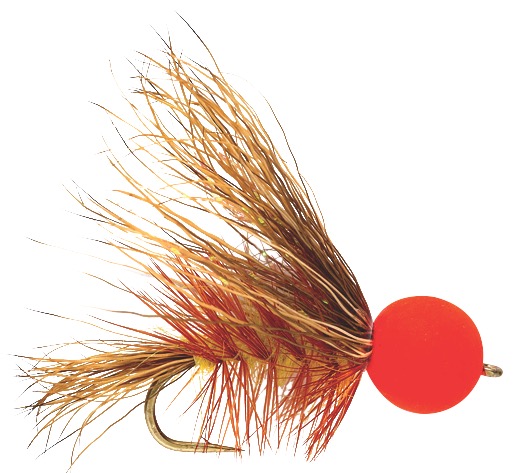
Nope, this is not a gag—it’s a real fly, available from actual tackle shops. Basically, Georgia-based fly tier Kevin Griffin took the venerable (and highly effective) Stimulator dry fly, stripped it down a mite, and stuck the fly equivalent of a clown nose on it. It’s original, creative and simple, making it one of those, “Why didn’t I think of that?” ideas. Let me explain.
On its own, the original Stimulator is a proven general-use dry fly. Since it’s long, bushy and floats well, the Stimulator is also popular in hopper-dropper rigs, with a nymph suspended below it. Owing to its dull colours, however, the Stimulator can be hard to see on the water, and in order to fish any surface fly well (with or without a dropper), you need to be able to see it. Of course, you can also fish a nymph under an easy-to-spot strike indicator, but the third or fourth time you see an overly enthusiastic trout take a whack at your indicator, you’ll want to exchange it for something with a hook. And that’s what the Griffin’s Stimicator is—a strike indicator that’s also a lethal fly in its own right.
- HOOK: Curved-shank 2XL dry-fly hook, sizes 8 to 10
- TAIL: Deer or elk hair
- BODY: Palmered brown hackle over sparse yellow dubbing (or just yellow tying thread)
- WING: Deer or elk hair, over few strands of pearl Krystal Flash
- HEAD: Round foam strike indicator, 5/16- or ¼-inch diameter
#7 HI-VIS PARACHUTE
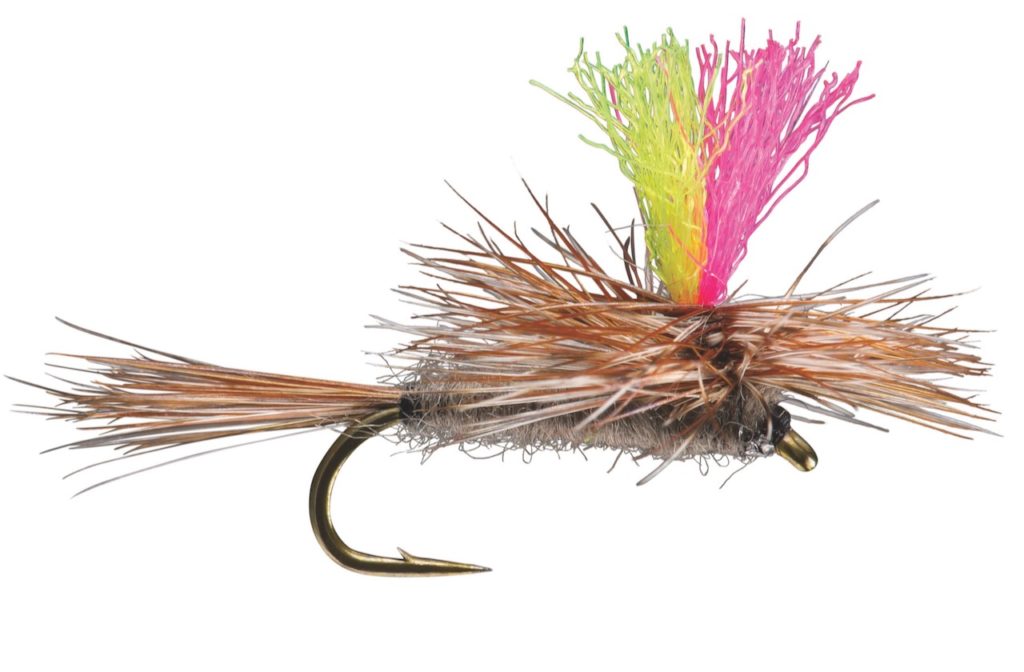
Conventional dry flies float thanks to a hackle feather wound around the hook shank. Parachute-style dries, on the other hand, have the hackle wound horizontally around a stout “wing post” of poly yarn, making for some cool effects. For starters, the horizontal hackle keeps the fly on top in current, yet lets it lands delicately on smooth water. Perhaps more importantly, the fly sits in the surface film rather than on it, just like an emerging mayfly does at the most vulnerable point of its lifecycle.
Parachute flies were slow to catch on, but the Adams—long North America’s most popular dry fly—has now been supplanted by the Parachute Adams. However, these wee little parachute flies have a problem: the typical white wing post is surprisingly hard to see amid the foam and bubbles on a river’s surface. Not so with the Hi-Vis Parachute’s hot pink or chartreuse wing post, which you’ll never lose sight of, even at dusk. The fish on the other hand, won’t be alarmed by the gaudy wing since it’s obscured by the horizontal hackle. The fly pictured here is tied in classic Adams colours, but you can apply the Hi-Vis principle to any beloved pattern, depending on your tolerance for clown colours.
- HOOK: Dry fly, sizes 12 to 18
- TAIL: Hackle fibres
- BODY: Sparse dubbing
- WING: Chartreuse and/or hot pink poly yarn, tied upright
- HACKLE: Parachute style