


Fishing Panama's Wild Coast… from a kayak
If you have a taste for true angling adventure, this is the place for you
Advertisement

In a way, I can’t believe I actually did it. Last December I flew to Panama, and then took a six-hour van ride across half the length of the country, to the end of the road, and literally as far south as you can drive. Then, my companions and I waded down a black sand beach, climbed into a brawny super-panga open boat, and bombed 90 minutes down the coast, with nothing but mountains and rainforest on one side, and the vast Pacific Ocean on the other, finally arriving at an off-grid eco-lodge, literally carved out of the jungle. And it was all to go fishing. But it was an angling experience unlike any other: battling powerful marine fish from 12-foot Hobie Mirage Outback kayaks.
Advertisement

The team at Panama Kayak Adventure calls it the Wild Coast—60-plus kilometres of near-virgin inshore fishing waters, off Panama’s spectacular Cerro Hoya National Park (above). It’s among the least pressured and most prolific saltwater fishing in Central America. And the target species are like a roll call of the most powerful and intensely sought tropical gamefish: cubera snapper, roosterfish, yellowfin tuna, dorado, amberjack, jack crevalle, trevally, plus various table fare such as smaller snappers, jacks and pompanos. And we hooked them all.

Advertisement
In my nine years as associate editor of Outdoor Canada magazine I’ve been to plenty of remote and wild places, and gone after some challenging fish. I’m also a very experienced kayak angler. But nothing prepared me for the impact this trip has had on my angling life. I’d call it a once-in-a-lifetime experience… except that I’m going back again this year with a whole crew of adventurous Canadians. Here’s why this destination was so special.

Advertisement
#1 The fish are plentiful and varied
The photo above shows just one of our group, Bob Deane from Denver, with a sampling of the species he landed over five days on the water. Clockwise from the top left, he shows off his: near-world-record needlefish, bluefin trevally, yellowfin tuna, roosterfish, African pompano and sierra mackerel.
Think for a moment about the Canadians you know who’ve gone fishing while on a tropical getaway to Cuba or Mexico. A single day on the water costs almost as much as your entire vacation, and then odds are you spend six hours trolling, while fighting off seasickness and catch… nothing. This does not happen on the Wild Coast, where the fish see minimal angling pressure, and there’s very little commercial or subsistence fishing.
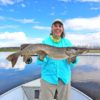
 (Clockwise from top left): Rob Dankowsky with a mutton snapper; the author with African pompano and jack crevalle; Jamie Nelson with a roosterfish
In fact, with the exception of a collage of jaw-dropping trophy shots near the end, ALL of the photos in this story were taken during my trip. Amazing.

#2 Kayaks are an exciting—and very effective—way to fish the Pacific coast
Using kayaks lets you safely fish near the rocky shore, where big boats would never dare go, opening up a near-virgin fishery, especially for the two of the eastern Pacific’s most prized gamefish: cubera snappers and roosterfish. But the pedal-powered Mirage Outbacks are also excellent for fishing a click or two offshore. Above is Jamie Nelson, also from Denver, with an eater-sized yellowfin tuna, taken on a surface popper.

From the lodge, we could fish a huge area, which we reached by loading the kayaks into the lodge’s custom built super-pangas (above). These stable, nearly indestructible boats are designed to comfortably carry four kayaks, anglers and fishing equipment.
So every day, we headed north or south along the coast (above), looking for the most promising fishing conditions. Then we unloaded the kayaks (below), and got to work, while the panga stayed nearby to act as a safety vessel.

And of course, with this system the lodge uses a fraction of the fuel required at full-powered operations, keeping the cost way down, which is partly why this trip was so affordable (more on this later).