

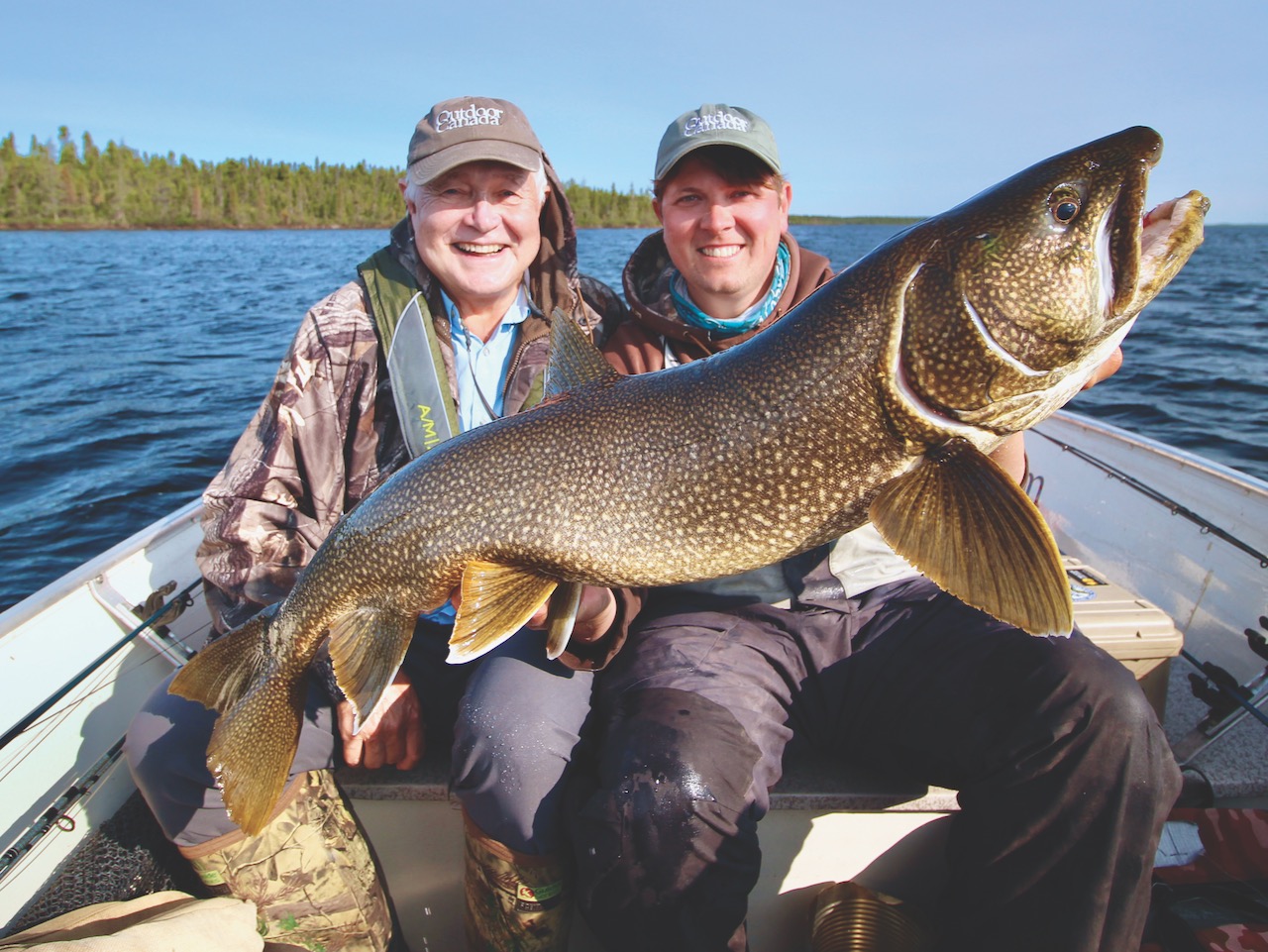
THE TRIPLE CROWN OF THE FAR NORTH
To catch trophy lake trout, northern pike and Arctic grayling in just one trip, head for the N.W.T.’s remote and wild Kasba Lake
Advertisement
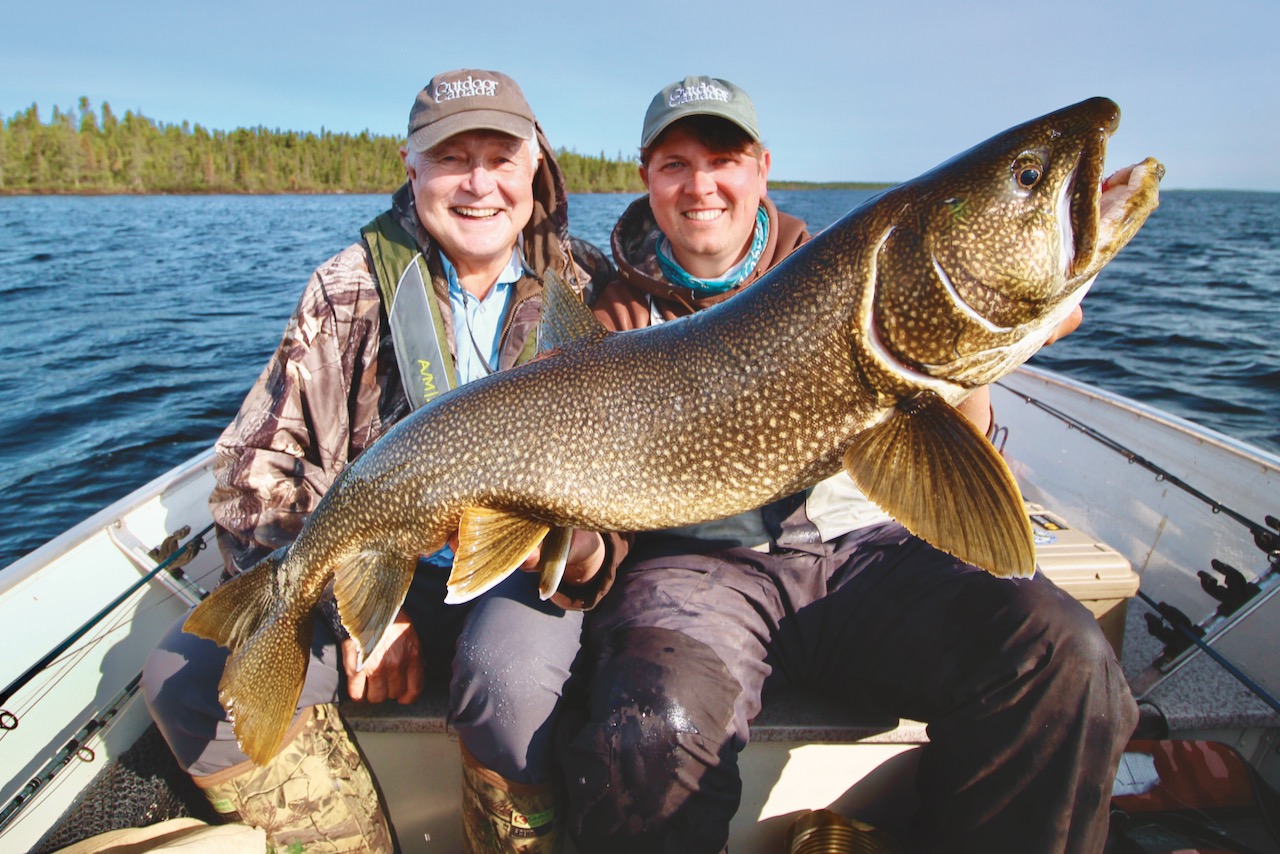
Pump and crank, pump and crank. On it went as my friend Lynn Henning steadily reeled another lake trout up from the cold, rocky depths of the N.W.T.’s Kasba Lake. Periodically, his rhythm was interrupted by the harsh, yet magical zinging of his drag as the fish powered away, taking back yards of hard-won line. For anglers who value the destination more than the journey, this probably sounds frustrating, but it was exactly what Lynn and I had travelled so far to experience.
Advertisement
After the fish’s third run, it was clear Lynn was connected to his largest laker of the trip so far, and he continued the battle with a combination of determination and something close to glee. Eventually, we saw a flash from his big silver spoon, followed by a shadowy outline. Then it was in the net—just over 20 pounds of huge-headed, deep-bodied lake trout, a truly formidable-looking predator (above).
Moments later, the fish was back in the water and swimming away. Along with our guide, Tyler Jones, we toasted the completion of our goal. Capturing that trout meant both Lynn and I had, after just four days on the water, completed the triple crown of Far North fishing. As life goals go, striving to catch a 20-pound lake trout, a 40-inch northern pike and a two-pound Arctic grayling on a fishing trip is pretty arbitrary, bordering on frivolous. Yet we found it oddly meaningful—complete with some wild and occasionally improbable adventures along the way…
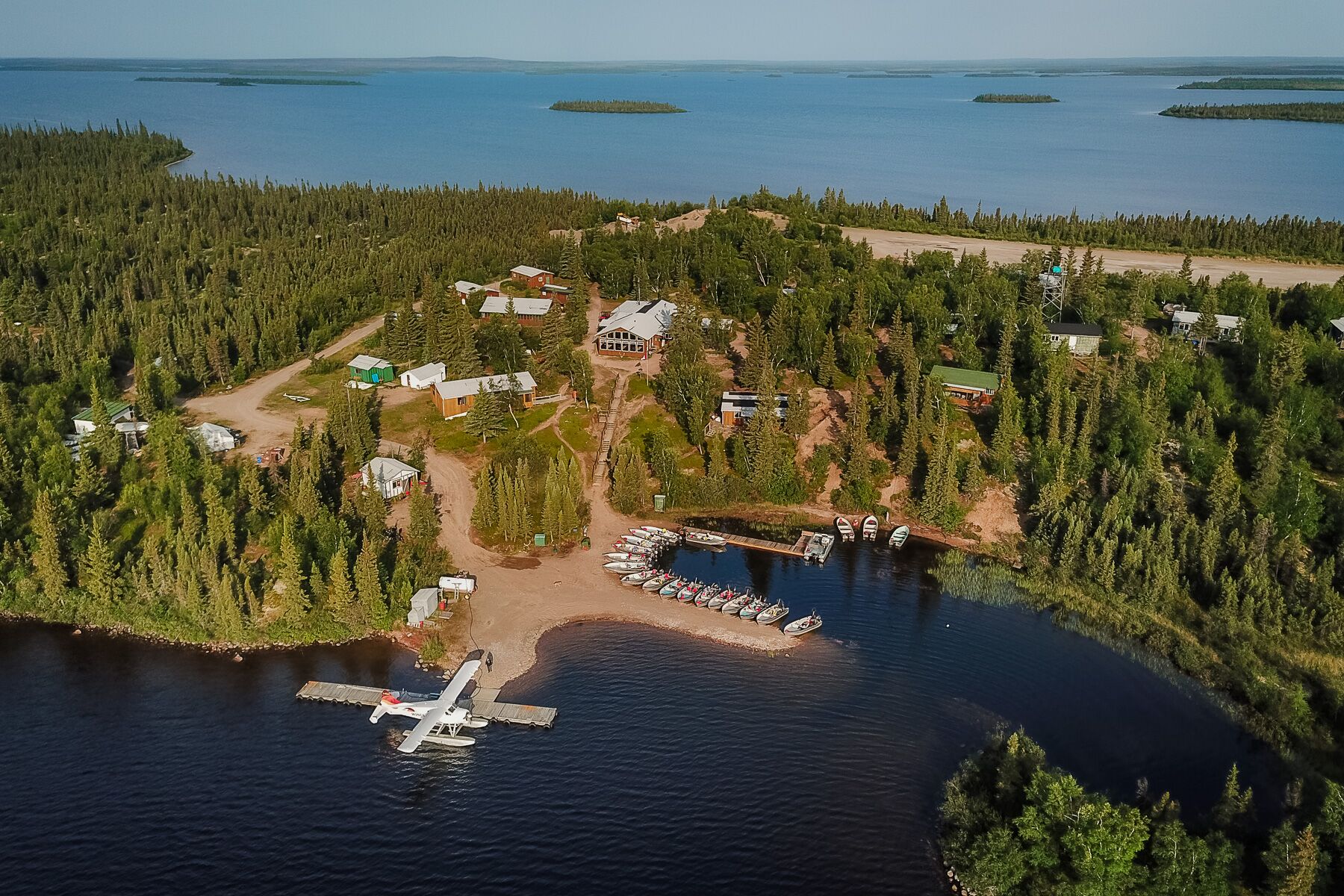 Kasba Lake Lodge seen from the air
THE EXPANSE
Situated in southeast corner of the N.W.T., and just edging into Nunavut, Kasba Lake is vast and remote. At 70 kilometres long, and 40 kilometres wide, it so dominates the surrounding landscape of scrubby boreal forest, wetlands and tundra, that it generates its own microclimate.
Advertisement
This renders forecasts, other than what you see out the window, useless. That’s not an exaggeration—pilots bringing in guests have to call the lodge office to learn about the landing conditions.
There nothing manmade on the lake’s 250-kilometre-long shoreline except the buildings of Kasba Lake Lodge. The first and only camp on the lake, it was established in the mid-1970s. Soon after, the owners introduced a 100 per cent catch-and-release policy for large fish, making it the first lodge in Canada to do so.
Advertisement
Kasba’s expanse includes both plunging depths and shallow bays—often next to each other—along with numerous inflows, outflows and channels, all criss-crossed by sunken eskers and dotted with dozens of islands. You could fish the lake for a lifetime and never cast a line in the same place twice. But we had less than a week.
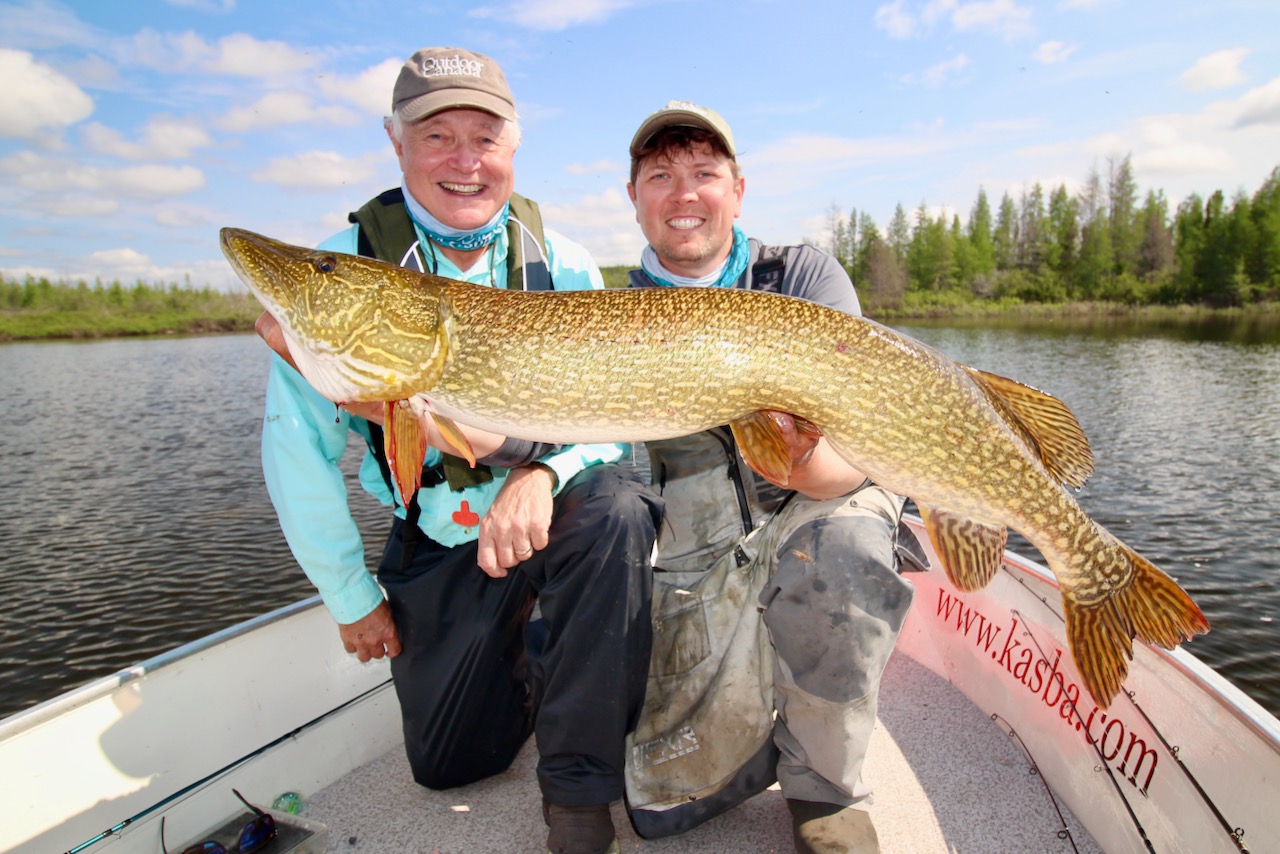 Lynn Henning and guide Tyler Jones show off Henning’s 45-inch pike
GORDO’S BAY PIKE
On our first full day in camp, Lynn and I set out to sample the entire Kasba fishing menu. We were in good hands with Tyler, who’d been fishing and guiding on Kasba and the surrounding waters since 2011. From Omemee, Ontario, Tyler was affable, often hilarious, and a triple threat: a trained fisheries and wildlife biologist, head guide and, in the off-season, Kasba’s sales manager.
We started in a classic pike bay near the lodge, where Lynn stuck a 36-inch fish. Switching gears (or rods, actually) we trolled our way out of Kasba’s large west-side bay, toward the main-lake basin, nabbing trout along the way. Greeted by stable conditions, we headed for a mid-lake hot spot called the Dome. The trout fishing there was a little frosty, but the water was so unusually calm, Tyler suggested we run all the way across the lake to a pike spot called Gordo’s Bay. It was July 11, still early in the Kasba calendar, and we’d be the first boat of the season to fish there.
A broad, shallow bay with a creek tumbling in, scattered sunken logs and the green highlights of emerging weeds, Gordo’s certainly looked like a prime pike spot. After a couple of casts with my 8-weight fly rod, I knew Gordo’s had the goods when a 40-inch pike snapped up my Supercharger fly, a swishy, suspending, all-tinsel eyesore beloved by northerns. As we took a quick photo, it was exactly 3:45 P.M.
Peering more keenly into the water, we then realized that many of those “logs” were actually very large pike, slowly cruising all around us. A few casts later, I hooked another northern. While I landed the fish, Lynn clipped a larger, lighter spoon to his leader. On his first cast into the swirling water below the inflow, a trophy pike smacked his clown-coloured Williams Whitefish. Then, unbelievably, we were landing big pike on every third or fourth cast.
Once the action slowed, Tyler backed us into slightly deeper water, where Lynn made a long cast, let his spoon flutter down, and hooked up yet again. Lynn is a long-time Detroit sportswriter, now semi-retired and living in the sunny south. Still a wordsmith, he said this pike felt like a “serious fish” compared to the 40-inchers. He was right—his 45-inch gator ended up being the biggest pike caught at the lodge that week.
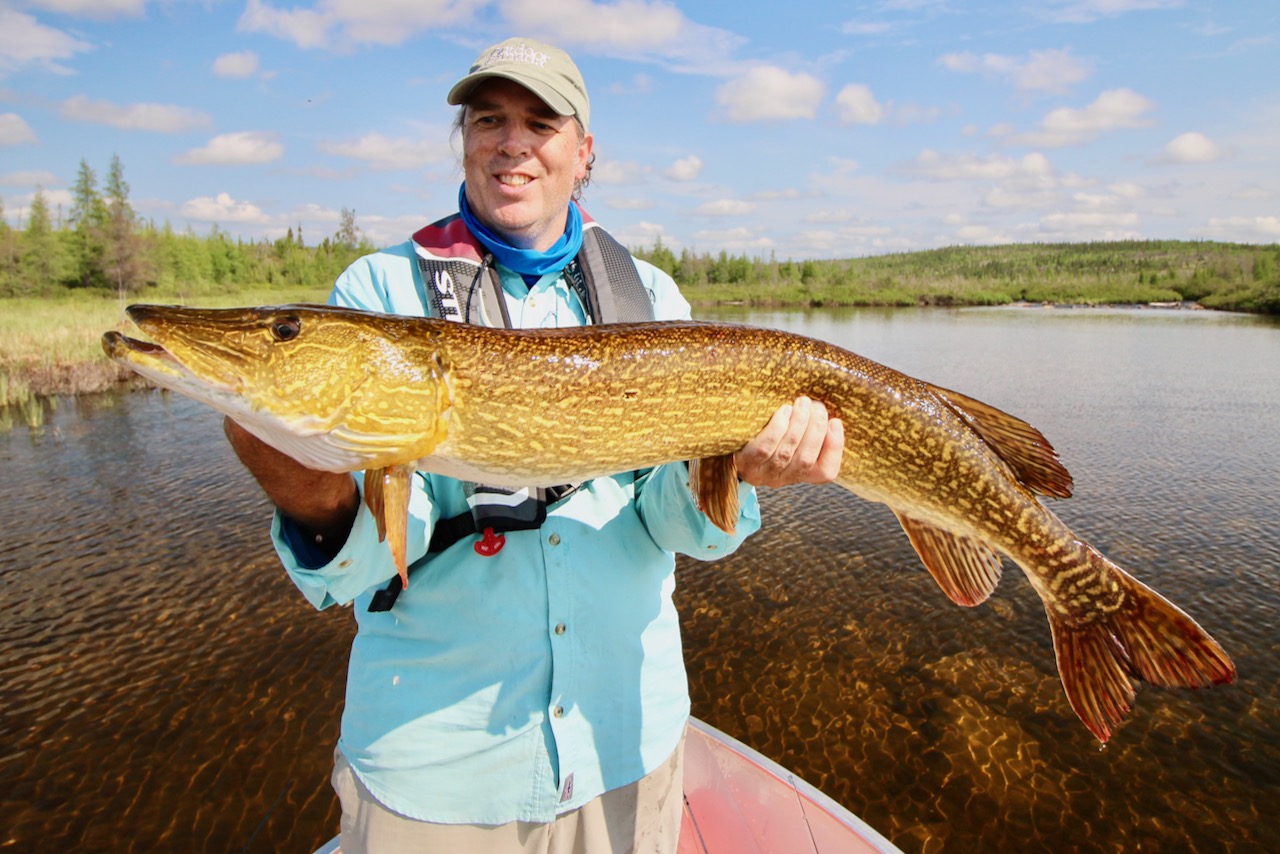 The author’s largest Gordo Bay pike
As Tyler carefully released Lynn’s trophy, I spied yet another big fish off the stern. It was just a boat-length away, apparently unconcerned by the commotion. A little unhinged by this sight, I artlessly plonked my fly on its snout, but still ended up tight to my biggest fish of the day, measuring 42 inches.
At 4:45 we headed back to the lodge. In 60 frenzied minutes on our first day, we’d landed five trophy pike, plus eight more fish longer than 34 inches—the kind of fishing I’d be thrilled with during a week on the water.